- Setting the from-to interval (period during which the application can be worked with)
You can select the date and time from and until which the ROPOT can be worked with. You can either enter both data or only one of them. You can set more than one interval for accessing the ROPOT. - Setting the total time for the test
Another option is to specify the total number of minutes that the ROPOT can be worked with. The time is counted for each person separately from the moment the ROPOT session is first launched. Although the teacher can set the student to return to the ROPOT session and work with it repeatedly, the total time is still counted from the first time the ROPOT session is launched. - Combining the two methods
You can combine both types of time restriction. The limit that expires first will apply. For example, you have a ROPOT where the interval is set to 15:00 to 16:00 and 10 minutes. If a student launches the ROPOT at 15:55, they will only have 5 minutes to answer it. If he/she opens it at 15:00, he/she will have 10 minutes.
The combination of time constraints can be used, for example, in real examinations for grades. For example, you want to give students 30 minutes of time and at the same time you don't want students to lose some of their time due to a delay in the start of the test. In such a situation it is convenient to set the interval e.g. 10:00–11:30 and at the same time the total number of minutes to 30. Each student will have 30 minutes to work and it does not matter whether he/she opens the test at 10:00 or 10:05. Only students who open the test at 11:01 or later would be disadvantaged.
You can do the same in tests designed for practice during the semester. For example, you want students to work with the ROPOT repeatedly over a period of time (e.g., March to May), but only for a limited amount of time (e.g., 20 minutes). In this type of testing, you need to have the parameter "yes, they should and some other questions should be offered to them next time they work with the ROPOT application". This is because if you set it to "yes, they should, but it is always the same form (same questions) that should be offered to them", the time from the first time the ROPOT session is launched is counted. In our case, if the student saved the test after 10 minutes and came back to it after half an hour, he/she would not be able to work with it anymore because the 20 minutes would have passed in the meantime.
Multiple periods during which the ROPOT can be worked with is useful in the case of tests on multiple dates for different groups or seminars within a course or courses using shared study materials. This eliminates the need to create multiple ROPOT descriptions for a single test that is intended for different groups of students. It is also important that all groups of students who are to work with the ROPOT at a given time also have the appropriate rights assigned. For example, you want to give one test to two groups of students. The first examination date is at 10:00, the second at 14:00. In the ROPOT description, you set the date and time in the first line to, for example, 10:00–11:00, and in the second line to 14:00–15:00. Thus, one description is used for two examination dates.
With both types of time constraints, the student can see how much time is left. For the last 5 minutes, a red warning appears on the counter indicating the end of the test and flashes for the last minute.
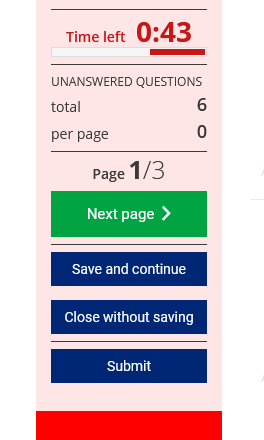
1 Students see that the time for answering the ROPOT is coming to an end.